

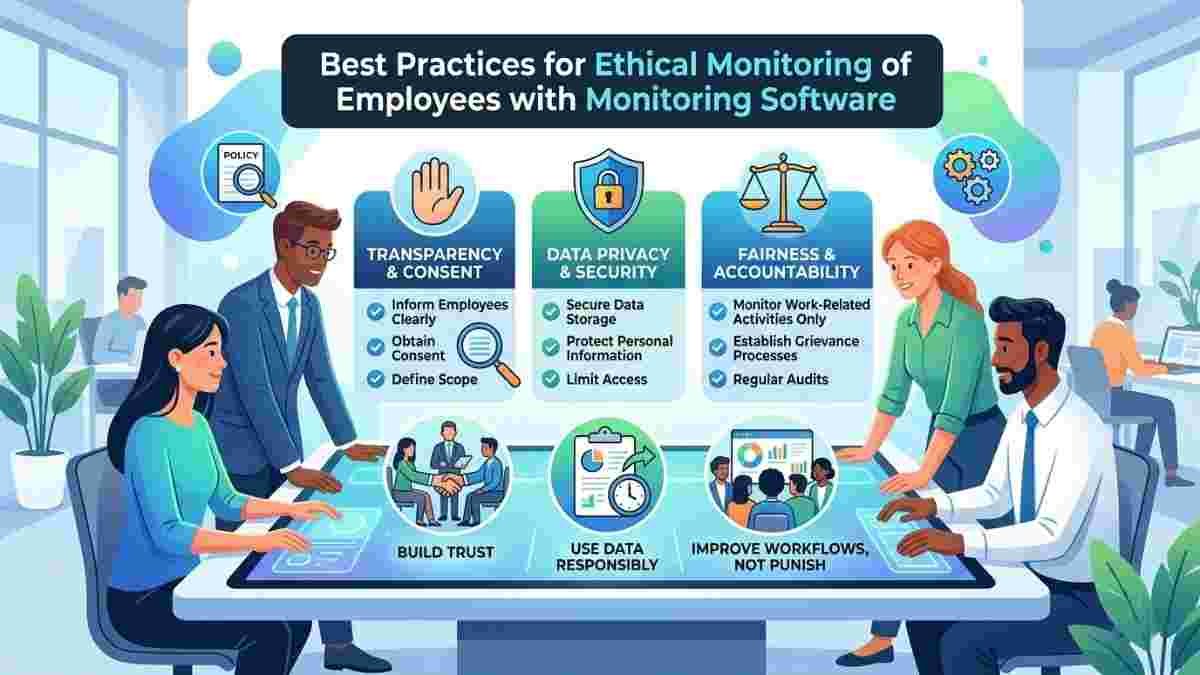
The drastic shifts in work environments have created challenges in adjusting to new demands. Striking the correct balance between the trust of employees and the productivity of the company has been a challenge. When employee monitoring software is used strategically, it can have a positive impact on a company and can even be seen as a company asset. Monitoring software use is not about surveillance but gaining insights into employee performance, protecting company assets, and obtaining legitimate information to evaluate performance fairly.
Monitoring performance is very challenging. Once it is explained to employee monitoring software is used to help improve individual productivity, it becomes less of a stress factor for employees. When choosing between monitoring software, look for the software that implements ethical performance monitoring.
The essence of ethical monitoring is looking at the work you do. Monitoring includes tracking time in order to ensure that employees are accountable for their productivity. Monitoring software has improved and implemented surveillance tracking through keystroke monitoring. They have focused on adjusting the resources available to help employees achieve their goals.
By aligning with the specific needs of the business, companies can cultivate accountability while still respecting the employee’s right to privacy. \
Effective employee monitoring software is designed with key features such as real-time summaries of employee activities, customized reporting, and notifications of atypical behavior. For example, ethical employee monitoring software or apps allows employees to pause tracking while they take a break. The software is designed so that employees have control of it. Employees can adjust their tracking to account for time away from their computer. This type of ethical employee monitoring software is geared towards employees and is made to help employees instead of monitoring them. The software created with employees in mind helps to improve the efficiency and effectiveness of teams. Controlio is the best example of ethical employee monitoring software.
If monitoring is done right, there is a mutually beneficial outcome to employers and employees. Employees have their workload and expectations adjusted based upon their individual needs instead of being done as a collective. Employees receive feedback and clear expectations, and burnout is prevented. Employers receive reduced operational risk, increased output, and better compliance with security standards. Studies show that engagement for employees increases with monitoring since they feel that their work is being acknowledged. In remote work, monitoring helps to align the objectives of the teams and the set goals. The use of monitoring in remote work helps retain the culture and purpose of the in-office atmosphere.
The potential of employee monitoring lies in the ethical practices used during its implementation.
Here’s how you avoid creating distrust from the start. Clearly state your collection practices. Provide your monitoring policy at onboarding so employees have clear access to this policy. Provide each employee the opportunity to clarify this during team meetings so employees become more familiar with the practice. To build trust, create policies that prevent tracking user activity outside of work hours, outside of work devices, and outside of work software. Adopt data minimization practices and avoid data retention and collection whenever possible. Provide employees access to their feedback and provide sessions to discuss their feedback so feedback collection practices become less of a surveillance practice.
Because they help build trust, audits and privacy impact assessments become critical. Just like the first one, every quarter should end with a review. Educating a workforce to have the same goals as a manager is the most useful goal from any tracking practice. Managers using this practice should be reticent to provide any negative feedback and even more so to provide a particularly large amount of feedback. Tracking employees without their knowledge may create the same high turnover that employee tracking is intended to avoid. Tracking practices become critical to a well-functioning workplace.
A properly constructed program’s compliance with regulations is arguably most important. In GDPR-compliant regions, monitoring must have a bona fide business reason, employees must be informed, and employees must have the option to access and/or delete the information. The CCPA (California Consumer Protection Act) and similar legislature in other parts of the world also have a consent requirement as well as a purpose limitation. Due to the complexity of legal issues with respect to international teams, cross-border legal issue checks should be done before international team rollouts. Compliance is also made easier with tools that provide encryption, access control by role, and audit logging that also eliminate the risk of the business and the employees being fined, sued, etc.
These systems have a myriad of real-world applications. In IT and customer support, monitoring is a necessary tool to obtain billable hours and response times without being considered a micromanager. It is also used in the education sector to promote honesty during online exams, by finance departments to prevent fraud and comply with regulations, and by healthcare administrations to access protected health information while also protecting the privacy of the patients. In all of these examples, the monitoring systems being used are utilized to promote responsibility as opposed to control and are designed in a way to promote collaboration in hybrid work environments.
Selecting a monitoring system should also be done with a great deal of care. Some of the most important factors are the potential for scaling to the size of your team, the potential for the monitoring system to integrate with the other systems you currently have in place, and ease of use by the users. It is also imperative that the system chosen offers a high level of privacy for its users as well as the ability to be used on mobile devices.
The pilot implementation, which involves starting with a small group, allows for feedback collection, which can then refine the policies for future phases of implementation. Having written policies combined with consistent training fosters understanding and creates a more positive workplace.
FAQs
What can companies use to monitor their employees without violating ethics or privacy?
The main parts of ethical employee monitoring are being open and having a balanced approach. Set policies, and then do the monitoring based on business needs. Employees will still have a measure of control over monitoring by being able to see their records. Overall, the focus should be on employee monitoring as a means for improvement rather than punitive measures, and policies must be periodically reviewed to control their scope.
Is employee monitoring software legal?
Provided that the software meets the laws of the area where the employees are located, there is employee monitoring software that is compliant with GDPR. Legality regarding monitoring employee activities should be balanced with the employee’s right to privacy. Legal advisors should be consulted when determining software parameters.
Is it possible for ethical employee monitoring to be successful?
The answer is yes. A system of ethical employee monitoring has factors that are designed to support employees. Examples of these factors are clear expectations and the objectives of a monitoring system.
The future of employee monitoring software will incorporate the use of AI for enhanced analytics, tools to predict workloads, and built-in privacy features.
Anticipate the arrival of highly personalized dashboards, behavioral coaching features, and modules that respect your privacy. As workplace cultures continue to shift, the ability to surveil employees in an ethical manner will create a competitive edge in a trust and flexible work environment.
In essence, workplace surveillance systems are a means of creating supportive, rather than combative, environments. Ethically designed surveillance systems will enhance productivity while fully preserving the dignity of employees. These systems, combined with good communication, will enhance the productivity of employees and create an environment of ethical surveillance. When implemented with care, these guidelines create lasting value for employees and employers.