
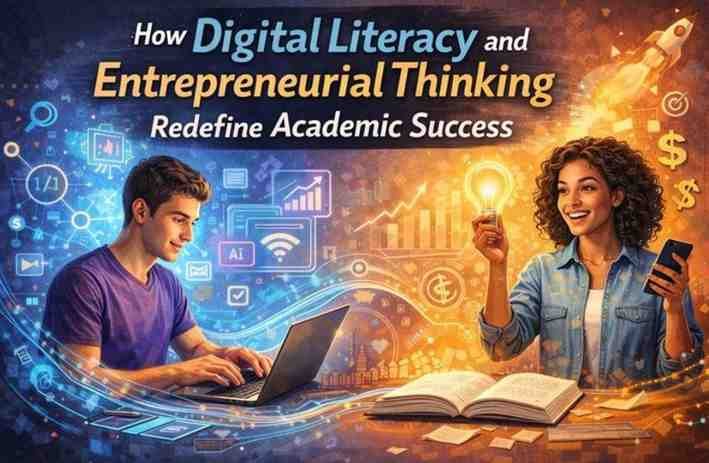
The definition of a “successful student” has undergone a seismic shift. Just a decade ago, academic success was measured by rote memorization and the ability to follow a rigid curriculum. However, as we move through 2026, the global economy rewards a different set of competencies. Today, the intersection of digital literacy and an entrepreneurial mindset has become the new benchmark for excellence.
For the modern student, university is no longer just a place to earn a degree; it is an incubator for the skills needed to navigate a volatile, AI-driven professional landscape. By mastering digital tools and adopting a founder’s logic, students can transform their academic journey from a passive experience into a proactive career launchpad.
The Digital Literacy Revolution: Beyond Basic Skills
Digital literacy is often mistaken for the simple ability to use a computer. In reality, it is the cognitive ability to search, evaluate, and create information using technology responsibly. For a student, this means moving beyond “Googling” and moving toward data synthesis.
In an era where information is infinite but attention is finite, the ability to process complex data is a superpower. Students are now expected to produce high-level research papers that require synthesizing dozens of academic sources, a task that makes specialized technology essential. For instance, when dealing with dense theoretical frameworks, many find it helpful to use the MyAssignmentHelp academic paraphrasing tool to break down complex jargon and rephrase ideas in a way that is clear and original. When used ethically, such tools are not “shortcuts”—they are pedagogical aids that help students master the nuances of academic tone and vocabulary.
By integrating these tools into their workflow, students free up mental bandwidth. Instead of getting bogged down in the mechanics of sentence structure, they can focus on the higher-order thinking: the “Why” and “How” of their research.
Entrepreneurial Thinking: A Mindset for Every Major

While “entrepreneurship” was once reserved for business students, it is now a universal requirement. An entrepreneurial mindset is not necessarily about starting a company; it is about problem-solving, resilience, and opportunity recognition.
Consider a first-year student. Traditionally, the first year is about survival—learning the ropes of campus life. However, applying an entrepreneurial lens changes the perspective. A student with this mindset views a difficult assignment not as a hurdle, but as a project to be managed. They view a gap in their knowledge not as a failure, but as a “market opportunity” to learn a new skill.
This proactive approach is especially critical for those entering the workforce for the first time. Navigating the challenges of first-year entrepreneurship requires the same grit and adaptability that a student needs to excel in a high-pressure academic environment. Whether you are launching a startup or a thesis, the principles remain the same: identify the problem, iterate on the solution, and remain resilient in the face of feedback.
Bridging the Gap: Where Technology Meets Ambition
The synergy between digital tools and a founder’s mindset creates a “Productivity Loop.” When a student uses technology to streamline their academic tasks, they create the time and space necessary to pursue side ventures, internships, or creative projects.
1. Strategic Task Delegation
In the business world, successful CEOs delegate. In the academic world, successful students “outsource” the repetitive and technical aspects of their work to reliable digital platforms. By leveraging AI-driven research assistants or formatting tools, students can maintain a high GPA without burning out. This strategic use of resources is a core entrepreneurial trait: knowing how to use the best tools available to achieve the highest quality output.
2. Information Integrity and Originality
One of the biggest red flags in both academia and business is a lack of originality. Digital literacy teaches students how to use sources without falling into the trap of plagiarism. Using an academic paraphrasing tool correctly allows a student to interpret a source’s meaning and re-contextualize it within their own unique argument. This skill—taking existing data and giving it a fresh, valuable perspective—is exactly what modern employers look for.
The Long-Term ROI: From Classroom to Boardroom
The ultimate goal of education is “Career Adaptability.” Statistics from 2025-2026 indicate that nearly 90% of new roles require advanced digital competencies. However, technical skills alone are not enough. Employers are looking for the “Intrapreneur”—the employee who treats their role with the ownership and innovation of an entrepreneur.
By cultivating these skills now, students are essentially “future-proofing” their lives. A student who can navigate a complex Learning Management System (LMS), utilize AI ethically for research, and manage their time like a project manager is miles ahead of a peer who relies solely on traditional study methods.
Actionable Steps for Students
To truly redefine your academic success, consider these three pillars of growth:
- Audit Your Tech Stack: Don’t just use the tools your professor gives you. Explore browser extensions for research, citation managers, and AI paraphrasers that help you refine your writing style.
- Treat Your Degree Like a Startup: Set quarterly “KPIs” (Key Performance Indicators). Are you networking? Are you building a portfolio? Your grades are just one metric; your growth as a thinker is the real “profit.”
- Practice Ethical Innovation: Use technology to enhance your voice, not replace it. The most successful entrepreneurs are those who use tech to solve human problems, and the most successful students are those who use tech to amplify their own human intelligence.
Conclusion
Academic success in 2026 is no longer a static destination. It is a dynamic process of constant learning and adaptation. By embracing digital literacy and an entrepreneurial spirit, students do more than just pass exams—they build a foundation of self-efficacy that will serve them for the rest of their professional lives.
About The Author
I’am Alexander Andeersonis an academic consultant at MyAssignmentHelp, I specialize in developing strategies that help students bridge the gap between complex research and clear, impactful writing. My work centers on the intersection of digital literacy and student success, focusing on how modern tools can be used ethically to enhance a student’s natural voice.